Attic Spray Foam Insulation
Open-cell or closed-cell spray foam applied to the attic floor or roofline to stop the heat loss and humid air infiltration that drive up winter heating bills and summer moisture problems in Akron homes.
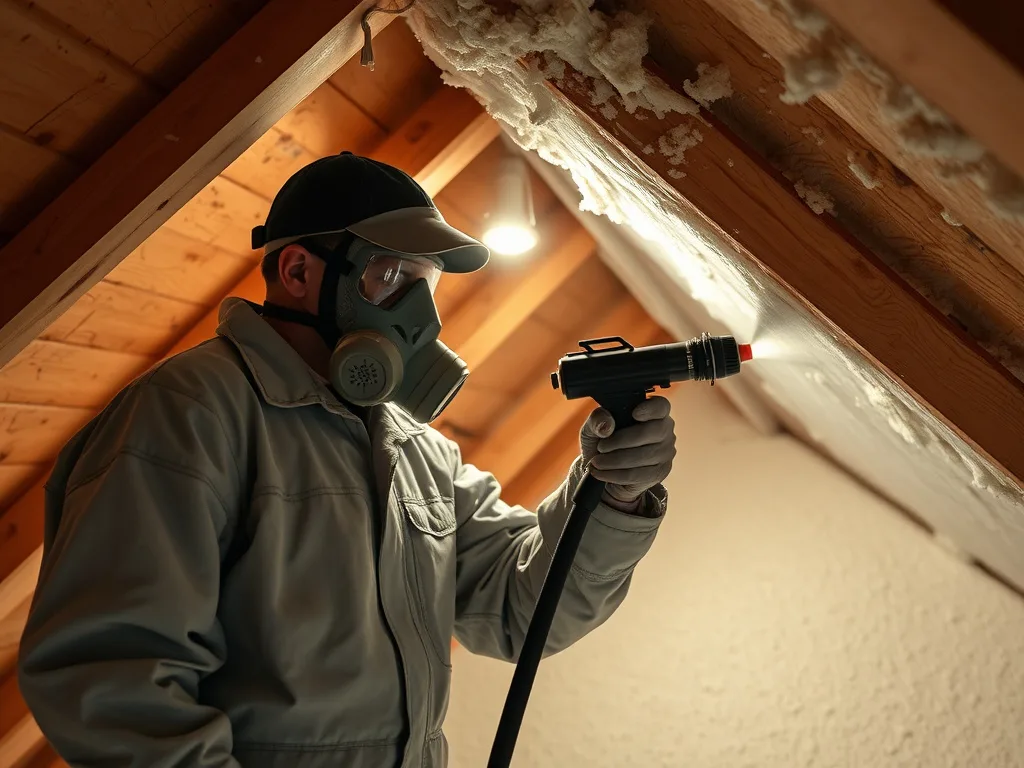
In a Zone 5A climate like Akron's, with roughly 6,160 heating degree days a year and January highs that rarely clear 35°F, the attic is usually the single biggest source of wasted heating dollars in a house. Warm, humid air rises and finds every gap around can lights, plumbing stacks, chimney chases, and attic hatches, then escapes through thin or settled fiberglass insulation that was never designed to stop airflow in the first place. That's especially true across Summit County's older housing stock — Akron, Cuyahoga Falls, Barberton, and Tallmadge all have significant pockets of pre-1939 construction, much of it balloon-framed, where original attic insulation has compressed to a fraction of its rated value over eight or nine decades.
Spray foam insulation solves a different problem than fiberglass batts or blown-in cellulose. Instead of just slowing heat transfer, it forms a continuous, adhered air barrier that blocks the bulk-air movement responsible for most real-world heat loss and for carrying humid interior air up into a cold attic where it can condense on the underside of the roof deck. Depending on the home, we apply spray foam at the attic floor in a traditional vented assembly, or at the roofline itself to create an unvented, conditioned attic — a common and effective approach for Akron homes with ductwork or mechanical equipment located in the attic space.
Why homeowners choose it
- Closes attic bypasses fiberglass and cellulose cannot seal, cutting winter heat loss at the source
- Forms a continuous air barrier that slows humid air infiltration into the attic cavity
- Reduces the roof-deck heat loss pattern that contributes to ice-dam formation along eaves and gutters
- Stabilizes attic and upstairs room temperatures, easing the load on furnace and AC equipment
- Adds rigidity to roof decking and helps dampen wind and rain/hail noise
- Holds its R-value over time instead of settling, sagging, or shifting the way loose-fill insulation can
Vented vs. Unvented Attic Assemblies
There are two standard ways to insulate an attic with spray foam, and the right choice depends on the house. A vented attic assembly applies spray foam across the attic floor, keeping the attic itself cold and ventilated the traditional way, with foam sealing the ceiling plane below. An unvented, or conditioned, attic assembly instead applies closed-cell or a hybrid open-cell/closed-cell system directly to the underside of the roof deck and gable ends, effectively moving the entire attic inside the home's thermal and air-sealing envelope.
Unvented assemblies are increasingly common in Akron-area retrofits because so many older homes have ductwork, furnaces, or water heaters located in the attic — equipment that loses significant efficiency when it sits in an unconditioned, vented space. Bringing that equipment inside the envelope with roofline spray foam can meaningfully improve HVAC performance without relocating the equipment itself. We evaluate roof structure, existing ventilation, and code requirements for each home before recommending either approach.
- Vented assembly: foam applied at the attic floor, existing soffit/ridge ventilation stays active
- Unvented assembly: foam applied at the roof deck, attic becomes part of the conditioned space
- Unvented is often preferred when ductwork or mechanicals live in the attic
- Ignition barrier or thermal barrier coating is required over exposed foam near living space per code
- Existing bath fan and kitchen exhaust ducting must be reviewed and often re-routed
- Roof deck condition and any prior moisture staining are checked before spraying
Why Air-Sealing Matters More Than R-Value Alone
A fiberglass batt rated R-38 sounds like it should perform close to spray foam, but R-value only measures resistance to conductive heat flow through a material — it says nothing about air leakage. In a real Akron attic, gaps around a chimney chase, an attic hatch, or a cluster of recessed lights can move more total heat than the R-value difference between insulation types ever will. That's the mechanism behind why homes with 'adequate' insulation still run cold, drafty upstairs rooms and high heating bills: the insulation is doing its job, but the air isn't being stopped.
Spray foam's adhesive, expanding application closes those bypasses as part of the install rather than as an afterthought. For Akron and Summit County attics, DOE and ENERGY STAR guidance for Zone 5A generally points to a typical range of R-49 to R-60 at the attic — R-60 where we're starting from a bare or badly degraded attic floor, R-49 as a common code-cycle baseline for retrofits building on existing insulation. We size the foam application to hit that typical range while treating the air-sealing as the primary performance target, not an afterthought to the R-value number.
Moisture Control and Ice-Dam Prevention in Akron Attics
Akron's humid continental climate means attic moisture is a year-round concern, not just a winter one. In summer, warm humid outdoor air can infiltrate a leaky attic and condense on cooler ductwork or framing; in winter, humid indoor air escaping upward through ceiling bypasses can condense on the underside of a cold roof deck, contributing to sheathing staining, mold-favorable conditions, and even nail-pop or frost accumulation in severe cases. A continuous spray foam air barrier addresses both directions of that moisture movement by stopping the bulk air transport that carries humidity into the attic in the first place.
On the winter side, Akron's freeze-thaw cycling and average of roughly 42 inches of annual snowfall create real ice-dam conditions when attic heat loss melts snow on the upper roof, which then refreezes at the colder eaves. This isn't a heavy-snow-load mountain problem the way it would be at elevation — it's a heat-loss problem, and it's solved the same way winter heating loss is solved: by stopping warm air from reaching the roof deck unevenly. Closing attic bypasses with spray foam evens out roof-deck temperature and reduces the melt-refreeze pattern that forms ice dams along Akron eaves and gutters.
Ideal for
- Pre-1939 and mid-century Akron-area homes with thin, settled, or wind-disturbed fiberglass
- Homes with a documented history of ice damming along the eaves or gutter line
- Attics housing ductwork, an air handler, or other mechanical equipment worth bringing inside the conditioned envelope
- Homeowners noticing big temperature swings between the upstairs and the rest of the house
- New roof, re-roof, or major attic renovation projects where the roof deck or attic floor is already open
What affects the cost
Attic Insulation questions, answered
A typical full attic spray foam project in the Akron area runs in the $2,500-$7,500 range as an industry estimate, depending on square footage, foam type, and whether old insulation needs removal first. Every attic is different, so the most accurate number comes from an on-site assessment where we measure the space and walk you through options.
DOE and ENERGY STAR guidance for Zone 5A generally points to a typical range of R-49 to R-60 at the attic floor or roofline, with R-60 more common when starting from bare or heavily degraded insulation. We'll confirm the right target for your specific attic during an assessment rather than quoting a single number over the phone.
Ice dams form when uneven roof-deck heat loss melts snow that refreezes at the colder eaves. Because spray foam closes the attic bypasses that cause that uneven heat loss, it's an effective secondary benefit for homes with an ice-dam history — though it works alongside good gutter and ventilation practices, not as a standalone fix.
Properly mixed, professionally installed spray foam cures and off-gasses within a standard 24-72 hour reoccupancy window recommended after application. Lingering odor is almost always a sign of a poor mix ratio, which is one of the main reasons we don't recommend DIY spray foam kits — a licensed, ratio-trained crew controls chemistry and cure conditions that a kit cannot.
Spray foam typically costs about two to three times more per square foot than fiberglass or cellulose upfront, but the air-sealing performance that loose-fill can't match usually pays that difference back through lower heating bills over time. We're happy to walk through both options and the tradeoffs during a free on-site assessment.
Attic Insulation done right, by a local Akron crew
Attic Insulation isn't a commodity — the result depends entirely on how carefully it's planned and installed for your specific home and Akron's real humid continental climate. We assess what your house actually needs, prep and air-seal properly, and install to your Zone 5A-appropriate R-value target, so the work delivers the comfort and savings it's supposed to.
We serve Akron, Cuyahoga Falls, Stow, Tallmadge, Barberton, Fairlawn, Green, Norton, Hudson, and Kent. Every job starts with a free, no-pressure quote.
Just as important, we treat your home like the system it is. Insulation, air sealing, and moisture management all interact, and getting one right while ignoring the others leaves comfort and savings on the table. When we scope your attic insulation, we look at how it fits the whole picture — so the finished result performs the way it should, holds up through a genuine Akron year, and actually lowers the bills you feel every month.
Free assessment
We evaluate your home and give you a clear, itemized quote.
Expert install
We prep, air seal, and install your attic insulation to spec — clean and on schedule.
Savings you can feel
A warmer home, lower heating bills, and honest advice about what your home needs.
Related services
Ready for a free attic insulation quote?
Tell us about your home and we'll put together a clear, no-pressure spray foam insulation quote — built for Akron's real winters, humid summers, and older housing stock.