Wall Spray Foam Insulation
Spray foam applied inside exterior wall cavities to stop drafts, even out room temperatures, and bring older Akron homes closer to a modern, air-sealed performance level.
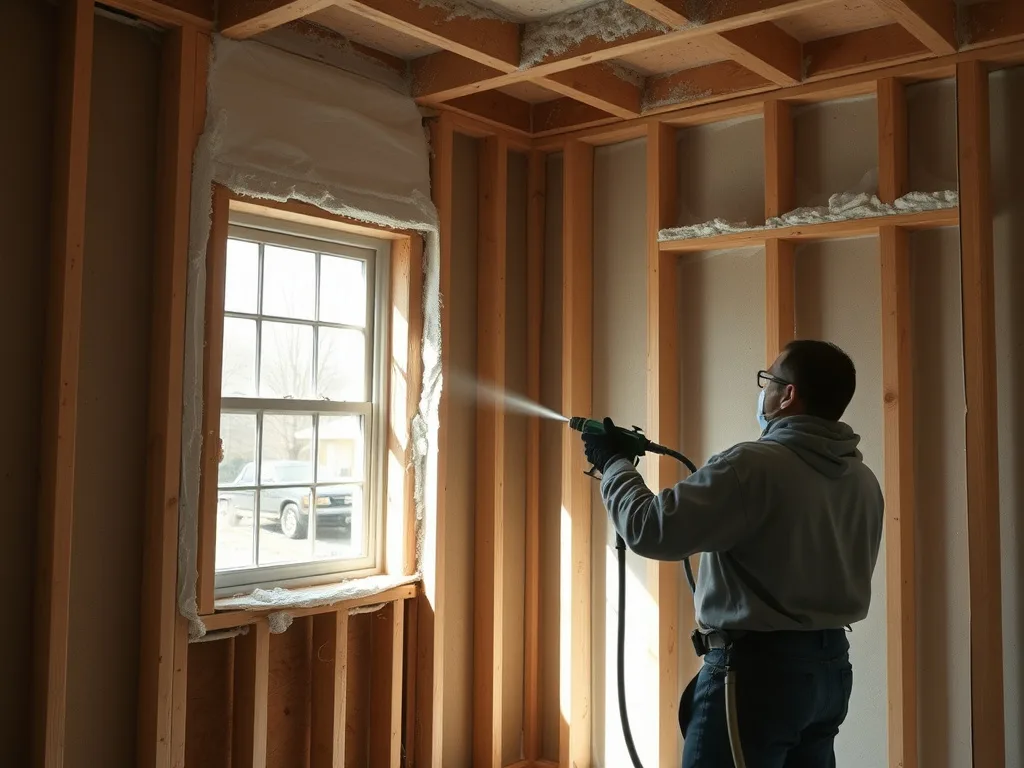
Exterior wall cavities are one of the most common weak points in Akron's older housing stock. Balloon-framed homes built before 1939 — a real share of Summit County's inventory — often have wall cavities that run continuously from basement to attic with little to no insulation at all, creating a chimney effect that pulls conditioned air out of the house and pulls in cold outdoor air along the way. Even homes with fiberglass batts installed at some point frequently have batts that were compressed, cut short around wiring and outlets, or never sealed at the top and bottom plates, leaving real air leakage in place despite the insulation being technically 'there.'
Spray foam addresses walls the same way it addresses attics and rim joists: by filling the cavity completely and adhering to framing, wiring, and sheathing to create a continuous air barrier, not just a layer of thermal resistance. For remodels, additions, and gut renovations where wall cavities are open, spray foam is often the single highest-impact upgrade available — closing drafts that no amount of caulk and weatherstripping around windows and doors can fully address on their own. We see this most clearly in older Akron and Cuyahoga Falls homes where a homeowner has already replaced windows and doors, addressed obvious drafts, and still feels a cold wall surface or a persistent chill in a specific room — a strong sign the wall cavity itself, not the visible trim, is the actual leak path.
Why homeowners choose it
- Fills wall cavities completely, eliminating the gaps and compression common in retrofit fiberglass
- Stops the drafts and cold spots that persist even in walls with some existing insulation
- Reduces the stack-effect airflow common in balloon-framed pre-1939 Akron homes
- Adds air-sealing around outlets, switches, and wiring penetrations as part of the application
- Improves comfort room-to-room by evening out wall surface temperatures
- Supports Zone 5A wall R-value targets without the thickness fiberglass alone would require
Open-Cell and Closed-Cell Options for Wall Cavities
Wall cavities can be filled with either open-cell or closed-cell foam depending on the wall assembly, budget, and moisture considerations. Open-cell, at a typical R-3.5 to R-3.7 per inch, fills a standard 2x4 or 2x6 wall cavity affordably while delivering strong air-sealing and sound dampening — a common choice for interior partition walls and many exterior walls in the right assembly. Closed-cell, at a typical R-6 to R-7 per inch, packs more R-value into the same cavity depth and can add a vapor-control layer where the wall assembly calls for one, which matters more on exterior walls exposed to Akron's freeze-thaw cycling.
For Zone 5A exterior walls, DOE and ENERGY STAR guidance points to a typical range of R-13 to R-21, commonly achieved with either roughly R-20 of cavity fill or a combination of R-13 cavity insulation plus R-5 of continuous exterior insulation. We size the foam choice and thickness to the specific wall assembly and target during the on-site assessment rather than defaulting to one product across every wall in the house.
- Open-cell: R-3.5-3.7 per inch, strong choice for interior walls and many exterior assemblies
- Closed-cell: R-6-7 per inch, adds vapor control where the assembly requires it
- Zone 5A wall target: typical range R-13 to R-21
- Common approach: roughly R-20 cavity fill, or R-13 cavity plus R-5 continuous insulation
- Wiring, plumbing, and outlet boxes are worked around during application
- Assembly-specific recommendation given during the on-site assessment
Retrofitting Wall Insulation in Older Akron Homes
Adding wall insulation to a home with finished interior or exterior walls is more involved than insulating open framing during a remodel, but it's a common and worthwhile retrofit across Akron's older neighborhoods. Depending on the wall's condition and whether interior drywall or exterior siding is more practical to open up, we can access cavities from either side to apply spray foam without a full gut renovation in most cases.
This retrofit work pairs naturally with other projects already opening up the walls — a kitchen or bathroom remodel, new siding installation, or window replacement all create access points where wall insulation can be added with minimal extra disruption. We're glad to look at timing wall insulation alongside other planned work during your on-site assessment, and we'll flag when a retrofit is genuinely a poor fit for a given wall rather than force an approach that won't perform well.
Cost vs. Fiberglass: The ROI Conversation
Spray foam typically costs about two to three times more than fiberglass batts installed in the same wall cavity, and it's a fair question whether that extra upfront cost is worth it. The honest answer depends on the home: in a wall cavity with real air-leakage problems — common in Akron's older stock — spray foam's air-sealing performance delivers heating-cost savings fiberglass batts structurally cannot match, because batts don't stop air movement even when correctly installed. In a newer, already tight wall assembly, the gap between the two options narrows.
We frame this as a payback conversation rather than a sales pitch: how drafty is the wall today, how many heating degree days does it face each winter, and how long do you plan to own the home. For many Akron homeowners in older housing stock, the air-sealing performance pays back the added cost over a reasonable ownership horizon, and we'll walk through the specifics for your home rather than asserting a blanket answer.
Ideal for
- Additions and gut renovations where wall cavities are already open
- Pre-1939 balloon-framed homes with minimal or no original wall insulation
- Homes with persistent drafts or cold spots along exterior walls despite existing batt insulation
- Room-by-room comfort complaints, such as a consistently cold corner bedroom or office
- Homeowners planning new siding or exterior work who want interior wall access addressed at the same time
What affects the cost
Wall Insulation questions, answered
As an industry estimate, wall spray foam typically falls within the broader $1.50-$5.00 per square foot range depending on foam type and cavity depth, with whole-house projects often landing in the $1,455-$4,338 range and a national average project cost cited around $2,889. We'll give you a specific number for your home during an on-site assessment.
In many cases, yes — depending on the wall's construction and condition, we can access cavities from the interior or exterior with limited disruption rather than a full gut renovation. We'll assess your specific walls and access options during the on-site visit.
DOE and ENERGY STAR guidance for Zone 5A generally points to a typical range of R-13 to R-21 for exterior walls, often achieved with about R-20 of cavity fill or a combination of R-13 cavity insulation plus R-5 of continuous exterior insulation.
It depends on how drafty the wall is today. In older Akron homes with real air leakage, spray foam's sealing performance typically delivers savings fiberglass structurally can't match; in newer, already-tight construction, the gap narrows. We frame this as a payback conversation during your assessment rather than a blanket recommendation.
Persistent cold spots or drafty rooms are frequently a wall air-leakage issue rather than an insufficient-insulation issue, which is exactly what spray foam is built to solve. We can evaluate the specific room during an on-site assessment to confirm the cause before recommending a fix.
Wall Insulation done right, by a local Akron crew
Wall Insulation isn't a commodity — the result depends entirely on how carefully it's planned and installed for your specific home and Akron's real humid continental climate. We assess what your house actually needs, prep and air-seal properly, and install to your Zone 5A-appropriate R-value target, so the work delivers the comfort and savings it's supposed to.
We serve Akron, Cuyahoga Falls, Stow, Tallmadge, Barberton, Fairlawn, Green, Norton, Hudson, and Kent. Every job starts with a free, no-pressure quote.
Just as important, we treat your home like the system it is. Insulation, air sealing, and moisture management all interact, and getting one right while ignoring the others leaves comfort and savings on the table. When we scope your wall insulation, we look at how it fits the whole picture — so the finished result performs the way it should, holds up through a genuine Akron year, and actually lowers the bills you feel every month.
Free assessment
We evaluate your home and give you a clear, itemized quote.
Expert install
We prep, air seal, and install your wall insulation to spec — clean and on schedule.
Savings you can feel
A warmer home, lower heating bills, and honest advice about what your home needs.
Related services
Ready for a free wall insulation quote?
Tell us about your home and we'll put together a clear, no-pressure spray foam insulation quote — built for Akron's real winters, humid summers, and older housing stock.