Basement & Rim Joist Spray Foam Insulation
Closed-cell spray foam applied to basement walls and the rim joist band above the foundation, addressing the moisture control and heat loss concerns of Akron's basement-dominant housing stock.
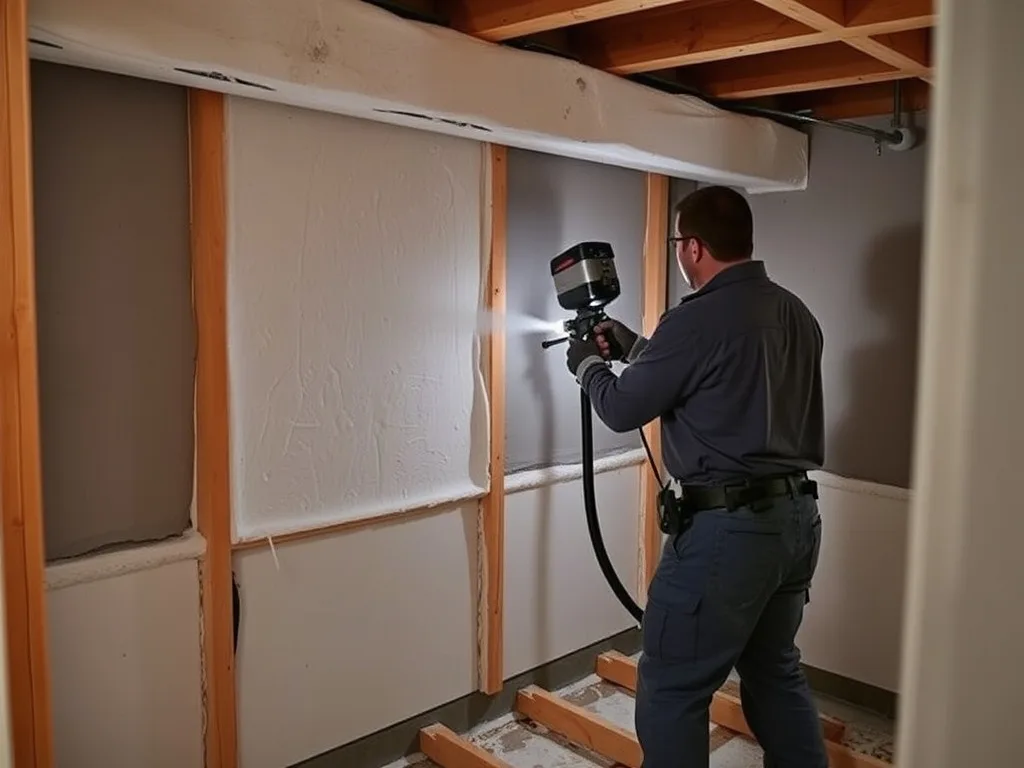
Basements are the dominant foundation type across Akron and the wider Midwest, unlike Sun Belt markets built mostly on slab or crawl space. That makes the basement, and specifically the rim joist band where the foundation meets the floor framing above, one of the highest-impact and most commonly under-insulated areas in a typical Summit County home. Rim joists in particular are notorious weak points: a narrow band of wood framing sitting directly above the foundation wall, frequently left with only a thin strip of fiberglass batt, or nothing at all, despite sitting at a major air-leakage and thermal-bridging location.
Basement walls face a different but related challenge — constant contact with soil moisture and, in Akron's freeze-thaw climate, real seasonal temperature swings at the foundation. Closed-cell spray foam is the right tool for both problems at once: it insulates, air-seals, and resists moisture intrusion in a single application, which is why basement and rim joist insulation gets its own dedicated service here rather than being folded into an attic or wall project.
Why homeowners choose it
- Closed-cell foam resists ground moisture where fiberglass batts absorb and degrade over time
- Seals the rim joist band, one of the most significant and overlooked air-leakage points in the house
- Reduces cold basement floors and drafty first-floor rooms directly above an uninsulated rim joist
- Adds structural rigidity to rim joists and band boards as the foam cures
- Helps control basement humidity, a common contributor to musty odors and mold-favorable conditions
- Improves comfort and efficiency in basements used as living space, offices, or storage for finished materials
Why the Rim Joist Matters So Much in Akron Homes
The rim joist, sometimes called the band joist, is the perimeter band of framing that sits on top of the foundation wall and supports the floor system above it. It's a small area in total square footage, but it's exposed on the outside face to full outdoor temperature swings while also being one of the leakiest points in typical residential framing — sill plates, joist bays, and penetrations for plumbing and wiring all converge there. In a home with 6,160 heating degree days a year, an uninsulated or poorly insulated rim joist band can account for a disproportionate share of total heat loss relative to its size.
Because closed-cell foam adheres directly to irregular framing and fills gaps around obstructions completely, it's particularly well suited to the rim joist's tight, cluttered cavity. A typical range for rim joist and basement wall applications is R-15 continuous insulation, or R-19 cavity fill, sometimes expressed as an R-13 cavity plus R-5 continuous combination — figures we confirm for your specific foundation during the on-site assessment rather than applying a single number to every house.
Basement Wall Insulation: Moisture Control First
Insulating a basement wall without addressing moisture first is a common mistake that leads to trapped moisture and long-term problems rather than solving anything. Before any foam goes up, we look at the basement's existing moisture conditions — visible dampness, efflorescence on block walls, prior water intrusion, or grading and drainage issues outside — because closed-cell foam controls vapor movement but isn't a substitute for fixing an active bulk-water problem at the foundation.
Once moisture conditions are understood, closed-cell foam applied directly to the interior face of the basement wall provides both insulation and a moisture-resistant barrier in one step, avoiding the trap that fiberglass batts and a poly vapor barrier can create in a basement wall assembly when installed incorrectly. This is exactly the kind of application where getting the assembly right the first time matters — a misapplied vapor barrier in the wrong basement assembly can trap moisture rather than manage it, which is why we treat this as a building-science decision, not a one-size product install.
- Existing moisture conditions assessed before any foam is applied
- Active water intrusion addressed separately from insulation, not painted over with foam
- Closed-cell foam applied directly to basement wall interior face
- Typical range: R-15 continuous, or R-19 cavity, sometimes R-13 cavity plus R-5 continuous
- Assembly designed to manage vapor drive rather than trap it
- Approach confirmed for your specific foundation type during the on-site assessment
Crawl Spaces: A Secondary but Real Concern
While basements are the dominant foundation type across the Akron area, some homes, additions, or outbuildings sit on crawl space foundations, and those spaces face similar moisture and air-leakage issues to basements, often magnified by proximity to bare soil and limited ventilation. Closed-cell foam applied to crawl space walls, combined with an appropriate ground vapor barrier, addresses both insulation and moisture control in these spaces using the same building-science principles as basement wall work.
If your Akron-area property has a crawl space rather than, or in addition to, a basement, we evaluate it using the same moisture-first approach described above during your on-site assessment, and can scope it as part of a combined basement-and-crawl-space project where a home has both.
Ideal for
- Akron-area homes with an unfinished or partially finished basement and an exposed rim joist
- Older, pre-1939 homes with original or no basement wall insulation
- Basements with a history of dampness, musty odor, or visible condensation on walls or pipes
- Homeowners finishing a basement for living space who want the envelope addressed first
- Homes with cold floors or drafts on the first floor directly above an uninsulated rim joist
What affects the cost
Basement & Rim Joist questions, answered
The rim joist sits directly on the foundation and is exposed to outdoor temperature swings while also being one of the leakiest points in typical residential framing, so an uninsulated rim joist can account for a disproportionate share of total heat loss relative to its size. It's one of the highest-value places to spray foam in a typical Akron home.
Pricing depends on linear footage of rim joist, basement wall square footage, and application thickness, and generally falls within the broader $1.50-$5.00 per square foot industry range for closed-cell foam. We provide a specific figure after measuring your basement and rim joist during an on-site assessment.
Misapplied in the wrong assembly, any moisture-resistant material can trap water rather than manage it, which is why we assess existing basement moisture conditions before spraying and design the application to control vapor drive correctly for your specific foundation. Correctly applied closed-cell foam is a moisture-control asset, not a liability.
Active bulk-water intrusion — visible leaks, standing water, or ongoing seepage — should be addressed separately before insulation goes in, since spray foam controls vapor and air movement but isn't a substitute for fixing a drainage or grading problem at the foundation. We'll flag this during the on-site assessment if it applies to your basement.
Basements are the dominant foundation type in the Akron area and get our primary focus, but we do insulate crawl space walls using the same moisture-first, closed-cell approach for homes or additions that have one. If your property has both a basement and a crawl space, we can scope them together during the assessment.
Basement & Rim Joist done right, by a local Akron crew
Basement & Rim Joist isn't a commodity — the result depends entirely on how carefully it's planned and installed for your specific home and Akron's real humid continental climate. We assess what your house actually needs, prep and air-seal properly, and install to your Zone 5A-appropriate R-value target, so the work delivers the comfort and savings it's supposed to.
We serve Akron, Cuyahoga Falls, Stow, Tallmadge, Barberton, Fairlawn, Green, Norton, Hudson, and Kent. Every job starts with a free, no-pressure quote.
Just as important, we treat your home like the system it is. Insulation, air sealing, and moisture management all interact, and getting one right while ignoring the others leaves comfort and savings on the table. When we scope your basement & rim joist, we look at how it fits the whole picture — so the finished result performs the way it should, holds up through a genuine Akron year, and actually lowers the bills you feel every month.
Free assessment
We evaluate your home and give you a clear, itemized quote.
Expert install
We prep, air seal, and install your basement & rim joist to spec — clean and on schedule.
Savings you can feel
A warmer home, lower heating bills, and honest advice about what your home needs.
Related services
Ready for a free basement & rim joist quote?
Tell us about your home and we'll put together a clear, no-pressure spray foam insulation quote — built for Akron's real winters, humid summers, and older housing stock.